MOL & Hitachi To Build Sea-Based AI Data Centres Using Recycled Ship Hulls
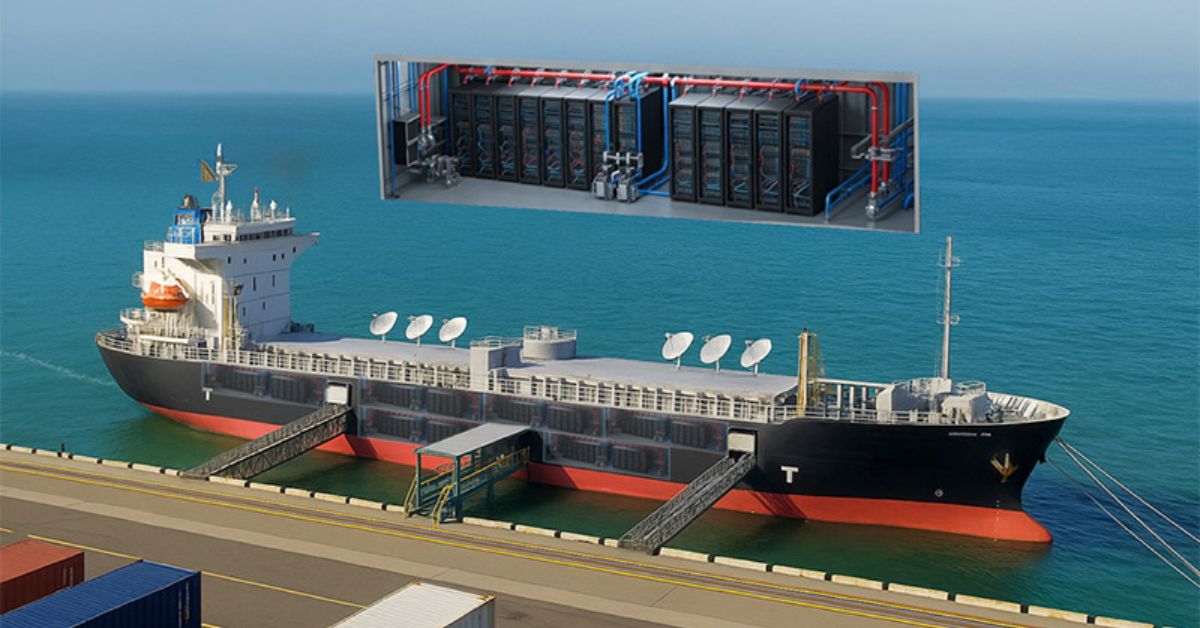
Mitsui O.S.K. Lines (MOL), Hitachi, Ltd., and Hitachi Systems, Ltd. signed a Memorandum of Understanding (MOU) to develop, operate and commercialise Floating Data Centres (FDCs) converted from decommissioned vessels.
The companies aim to address the surge in demand for data centres and smart generative AI systems across the maritime industry.
Depending on their experience, industry insights and expertise, the companies will assess the feasibility of commercialising an FDC converted from a second-hand vessel.
The companies say it is the ideal solution, which eliminates the need to secure land, enabling shorter construction periods, thus reducing the project’s environmental footprint and costs through the reuse of old ship hulls.
Additionally, land-based data centres need water for power generation, cooling, disaster management plans and most importantly, they should be at a strategic location.
Floating data centres are mobile and can go anywhere, and are much safer to operate than land-based counterparts.
According to the agreement, MOL will oversee vessel conversion planning, mooring requirements, and coordination with port authorities.
Hitachi and Hitachi Systems will provide the technical backbone, leveraging their “HMAX by Hitachi” suite to design IT infrastructure, security, and specialised cooling systems.
There are many benefits of floating data centres, highlighted in the press release, including
- Reduced environmental impact from the use of existing ships, which does away with the need to process raw material and build a structure from scratch.
- Using ship-onboard systems like water intake, power generation and air conditioning to reduce initial investment.
- Availability of enormous space. For eg, a car carrier with a floor area of approximately 54,000 m2 could easily rival one of Japan’s largest onshore data centres.
The companies have said that it would take only a year for the conversion process, which is far less than building a new data centre on land.
Also, the floating data centres will use seawater and river water to cool the AI servers, thus reducing energy consumption.
They can also be relocated anywhere to meet the regional demands.
The focus of the project will be Japan since Hitachi Group has considerable experience there when it comes to land-based data centres, as well as the U.S and Malaysia.
Operations are scheduled to commence in 2027 or a little later.
Want to read more?
Check out the full article on the original site