Container Ships: History, Types, Sizes & How They Work
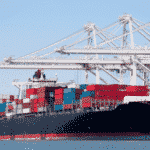

On April 26, 1956, SS Ideal X, a converted World War II oil tanker, left the port of Newark for Houston on a 5-day journey with 58 metal containers on its deck. At that time, the cost of loading a ton of cargo was approximately $5.83.
However, on that ship, it cost just $0.16, all because of the standardised steel box, which revolutionised shipping more profoundly than any maritime technology since the steam engine.
Today, around 5,500 container ships carry 90% of the world’s non-bulk cargo, and the largest vessels can hold 24,346 twenty-foot equivalent units (TEUs) while afloat.
This article explains what container ships are, how they are built and operate, and where container shipping is headed.
What Is a Container Ship?

A container ship, also referred to as a boxship or cellular vessel, is a type of cargo vessel which can accommodate standardised intermodal containers; basically, steel boxes built as per ISO specifications, enabling them to be transferred between ships, trucks, and rail cars without unpacking their cargo.
Cargo capacity of container ships is measured in TEUs, wherein a standard 20-foot container equals 1 TEU, and a 40-foot container equals 2 TEUs.
When a ship is described as having a capacity of 24,000 TEU, it can carry the equivalent of 24,000 such 20-foot boxes.
The term “intermodal” is why the system works. A container loaded at a factory in Shenzhen can travel by truck to a port, be loaded on a ship, cross the Pacific, be offloaded at Los Angeles, be placed on a train, and be delivered to a warehouse in Chicago without the need to repackage the cargo.
A Brief History of Container Ships

Before containerisation, cargo was loaded on ships piece by piece, often packed in crates, drums, barrels, and sacks in a process called break-bulk shipping. A medium-sized vessel at a major port took almost a week to unload its contents since they were all loaded individually.
Then there were other concerns, such as pilferage, damages, cargo losses, on top of high labour costs, which made the whole affair rather expensive.
Surprisingly, the solution for this problem came not from a shipping firm but from a trucking entrepreneur named Malcolm McLean, a North Carolina haulage businessman.
He said that if truck trailers could drive onto ships, the handling time and cost would be less. After he acquired the Pan-Atlantic Steamship Company, he built on this idea further and said that rather than loading entire truck trailers, only the detachable containers should go aboard to maximise the cargo-to-weight ratio.
The concept was practically demonstrated in SS Ideal X’s maiden voyage in April 1956.
After this, MV Kooringa became the world’s first purpose-built, fully cellular container ship, which was commissioned in 1964. By 1966, the first transatlantic container service was launched.
The 1970s saw rapid standardisation under ISO specifications, locking in the 20-foot and 40-foot lengths that remain universal today.
As time passed, vessels grew bigger in size, from the 1,000-TEU Panamax in the 1970s to the sub-20,000-TEU giants that followed the Panama Canal’s 2016 expansion.
The container carrying capacity of the global fleet has grown by more than 1,200% since 1968.
The most recent record was made in 2023, when MSC Irina entered service with a capacity of 24,346 TEU, the equivalent cargo of 16 pre-war freighters.
Types of Container Ships

Container vessels are classified in two ways: by how they handle cargo and by their size.
By Handling Mode
1. Gearless (Lo-Lo) Ships
These are the most common container ships with no onboard cranes, making them solely dependent on shore-based ship-to-shore (STS) cranes at the port for loading and unloading cargo.
They account for more than 90% of global cellular container capacity and sail on high-volume or busy routes where ports are well-equipped.
2. Geared (Lo-Lo) Ships
Geared container vessels have their own deck cranes, allowing them to operate independently at smaller ports which do not possess container-handling infrastructure. They represent approximately 7.5% of global fleet capacity.
3. Ro-Con (ROCON) Ships
ROCON vessels combine roll-on/roll-off capability with container capacity. These vessels enable cargo with wheels, such as vehicles, to be driven on the ship via ramps and containers are stacked on the hold or the upper deck.
They serve mixed cargo trades where a single ship type needs to accommodate both types of cargo.
By Size
The industry uses 7 standard size categories, each based on the dimensions of the world’s major shipping canals.
| Class | TEU Range | Approx Length | Notable Context |
|---|---|---|---|
| Small Feeder | Up to 1,000 | ~100 m | Coastal and island routes |
| Feeder | 1,000–2,000 | ~150 m | Regional hub-to-port services |
| Feedermax | 2,000–3,000 | ~200 m | Larger regional trade |
| Panamax | 3,000–5,100 | Up to 294 m | Built to the original Panama Canal dimensions |
| Post-Panamax | 5,100–10,000 | 300 m+ | Too wide for the original Panama Canal |
| Neo-Panamax | 10,000–14,500 | Up to 366 m | Fits the expanded Panama Canal (2016) |
| Ultra Large (ULCV) | 14,500–24,346 | ~400 m | Asia–Europe mainlane only |
Panamax vessels are now constrained by the original Panama Canal lock dimensions, a maximum length of 294.1 m, a beam of 32.3 m, and a 12 m draught. They were introduced around 1980 and carried 4,000 to 5,100 TEU.
Then came the Post-Panamax ships that exceeded the original canal’s beam limit and were barred from the Panama route until the canal’s third set of locks opened in 2016. Regina Mærsk (1996), with an official capacity of 6,400 TEU, marked the beginning of this class.
Neo-Panamax vessels were designed to pass through the expanded canal locks, measuring up to 366 m lengthwise and 49 m breadthwise. Ships such as HMM Algeciras with a 23,964 TEU capacity fall into this category.
Ultra Large Container Vessels (ULCVs) operate only on high-density lanes, primarily Asia–Europe, where port infrastructure can handle their 400 m length and 60 m beam. The current record holder in this category is MSC Irina, delivered in 2023 with a capacity of 24,346 TEU.
How Does a Container Ship Work?

When a container moves from its place of origin to its destination warehouse, it goes through several processes.
Pre-Departure and Loading
Before a container ship leaves port, a stowage plan is prepared by the cargo planner in which the location of every container is mentioned clearly, within the ship’s specific bay, row and tier to achieve perfect weight distribution, which is important for ship stability and to segregate cargo as dangerous goods.
Most importantly, this is needed because of port rotation, as containers that need to be unloaded at the first port of call must be accessible without moving the others.
At the port, ship-to-shore (STS) gantry cranes position each container precisely. Inside the holds, cell guides, which are vertical steel rails lining the hold walls, channel each container into its slot without the need for precise crane positioning. The container slides down the guides and seats itself automatically.
Containers are stacked up to six or seven tiers high above the hatch cover, and every container is secured to the one below it with the help of twist-locks that engage the corner castings of the ISO container frame.
Lashing rods and turnbuckles apply additional tension to the stack. The twist-lock mechanism is rated to a shear strength of approximately 48 tonnes and helps prevent rolling and pitching at sea.
At Sea
A loaded container ship, say on an Asia to Europe route, sails at a speed of 18 to 22 knots. Since the fuel prices increased in the early 2000s, slow speeds between 12 and 15 knots became a standard, as it was also found to have reduced fuel consumption by 60%.
A major challenge faced by container ships is stability. When containers are stacked high, the ship’s centre of gravity also increases. Ballast tanks work continuously to compensate, and cargo planners weigh the stowage plan to keep the ship’s metacentric height within safe operating limits.
Parametric rolling is another issue which poses significant risks in heavy seas, causing containers to collapse and even fall overboard.
Port Arrival and Unloading
When a ship arrives at its destination port, a pilot boards it and guides it to its designated berth. Mooring takes half to one hour, and simultaneously loading or unloading begins with the help of STS cranes. After this, cargo is scanned and directed to the yard.
A modern terminal can handle 30 to 40 container moves per crane hourly. Custom clearance and documentation happens parallely, which speeds up the process.
A large ULCV on a regular mainlane service completes its port call within 24 to 48 hours before leaving for the next port.
Container Ship Design

A container ship’s hull is narrower and more streamlined at the bow compared to a bulk carrier or oil tanker of similar size. The reason behind this difference in design is that container vessels operate at relatively higher speeds, and a finer entry decreases the wave-making resistance at 18 to 22 knots.
The internal structure is robust and built around a strong keel with transverse frames which enclose several cargo holds below the main deck.
The double-bottom space between the outer hull plating and the tank top has ballast water tanks, fuel oil tanks, and fresh water tanks. Below the cargo holds is the engine room, which occupies the aft section of the vessel.
Most container ships have two-stroke, slow-speed diesel engines, which run on heavy fuel oil or LNG if the vessel has a dual-fuel configuration. These engines drive a single large-diameter fixed-pitch propeller.
The bridge and accommodation block on conventional container ships can be found at the stern.
However, on the largest ULCVs, where a 400 m long forward deck creates a severe visibility problem from an aft bridge, some newer designs position the superstructure further forward to comply with SOLAS navigation line-of-sight requirements.
Hatch covers, which are the large steel lids that seal each cargo hold, are lift-away types on most modern vessels, serving a dual purpose.
Firstly, they prevent water ingress into the hold, and secondly, they provide a platform on which additional containers can be stacked above deck.
The cleats securing hatch covers must be closed and dog-wrenched tight before departure from any port.
Types of Containers Carried

Not all containers are the same. While a dry standard box is by far the most common, specialised container types handle the full range of global cargo.
| Type | Description | Common Cargo |
|---|---|---|
| Dry Van (Standard) | Fully enclosed, general-purpose | Electronics, clothing, machinery (~90% of all containers) |
| Refrigerated (Reefer) | Temperature-controlled, -30°C to +30°C | Meat, fish, pharmaceuticals, flowers |
| Open Top | No roof; canvas cover | Machinery, timber, oversized cargo |
| Flat Rack | Collapsible sides, open top and sides | Heavy machinery, vehicles, pipes |
| Tank Container | Cylindrical tank in ISO frame | Liquid chemicals, food-grade liquids |
| Side Open | Full-length side door | Carpets, timber, long cargo |
| Tunnel | Doors at both ends | Pass-through cargo loading |
ISO containers are manufactured in two primary lengths: 20 feet (1 TEU) and 40 feet (2 TEU), with a standard width of 8 feet and heights of either 8 feet 6 inches (standard) or 9 feet 6 inches (high-cube).
The 45-foot container is becoming more common, particularly in European road-sea intermodal movements where the extra length aligns with truck trailer dimensions.
Container Shipping and Global Trade

Container shipping makes up the majority of global maritime trade. About 90% of the world’s non-bulk cargo travels by sea in containers, representing an estimated $14 trillion in goods annually.
The 3 busiest trade lanes for container shipping are the Asia–Europe route via the Suez Canal, the Transpacific route from Asia to the US West Coast, and the Transatlantic route from Europe to the US East Coast.
The Asia–Europe trade route accounts for roughly 25% of global container trade by TEU volume.
The container shipping industry is dominated by very large carriers, four of which are MSC, Maersk, CMA CGM, and COSCO, which together control approximately 53% of global cellular fleet capacity as of 2024.
To fill vessels efficiently and share operating costs on high-volume routes, these carriers have also grouped into alliances.
The Ocean Alliance is made up of CMA CGM, COSCO, and Evergreen; THE Alliance includes Hapag-Lloyd, ONE, and Yang Ming, and they coordinate sailing schedules and vessel-sharing arrangements across the major east-west routes.
While container shipping is relatively safe, container losses at sea also occur. Per estimates, 2,000 to 10,000 containers are lost overboard annually, with the total insured value running into hundreds of millions of dollars.
The World Shipping Council recorded 3,133 containers lost in 2020-21, largely due to severe weather incidents in the North Pacific.
The Future of Container Shipping

The container shipping industry is faced with the largest structural change since Malcolm McLean invented the metal box.
The International Maritime Organisation’s target of net-zero greenhouse gas emissions from international shipping by or around 2050 requires a major change to the fuels that have powered the industry for over a century.
Heavy fuel oil remains the dominant marine fuel, but the transition is underway. LNG is the most widely adopted alternative today, offering approximately 20 to 25% lower CO₂ emissions and near-elimination of SOx, even though its methane slip remains a concern.
Maersk has taken a different direction, commissioning 18 vessels capable of running on green methanol, with the first, Laura Mærsk, entering service in 2023.
Ammonia is considered the most promising zero-carbon fuel for the longer term, but commercial-scale marine engines are still in development.
Wind-assisted propulsion has returned to commercial shipping after a century’s absence. Flettner rotors, which are tall spinning cylinders that generate lift using the Magnus effect, are installed on several container and cargo vessels, with operators reporting fuel savings of 5 to 15% depending on routing. Rigid sails and suction wings are in advanced trials on other vessels.
Port automation and AI-driven logistics optimisation are improving terminal throughput, and this technology is being rapidly adapted on ports across the world.
The question of whether vessel sizes will continue to grow beyond 25,000 TEU is increasingly debated. The infrastructure costs of deepening ports and widening fairways to accommodate even larger ships may outweigh the per TEU savings from the size increment.
Frequently Asked Questions

1. What is the largest container ship in the world?
As of 2025-26, the world’s largest container ship is MSC Irina. It is operated by Mediterranean Shipping Company. Delivered in 2023, it boasts a capacity of 24,346 TEU and is 400 m long, 61.5 m wide and has a 16.5 m draught.
2. What does TEU stand for in shipping?
TEU stands for Twenty-foot Equivalent Unit, and it is the standard measure of container ship capacity, based on the dimensions of a 20-foot ISO container. A 40-foot container, the most common size in actual use, equals 2 TEU.
3. Who invented the container ship?
The modern container ship was invented by Malcolm McLean, an American trucking entrepreneur, who developed the concept of standardised intermodal containers in the mid-1950s. The first voyage of a container ship, the SS Ideal X, took place on April 26, 1956, from Newark to Houston.
4. How fast does a container ship travel?
Container ships operate at 18–22 knots (33–41 km/h) under normal service conditions. Slow steaming at 12–15 knots has been widely adopted since 2008 to reduce fuel consumption, since fuel burn increases roughly as the cube of speed.
5. How long does it take to load a container ship?
A large container ship with a capacity of 15,000–24,000 TEU typically requires 24 to 48 hours in port for loading and discharge operations.
6. How many container ships are there in the world?
As of 2026, there are around 6000 active container ships in the world, with a combined capacity of over 25 million TEU.
You may also like to read:
- Top 10 World’s Largest Container Ships In 2020
- Understanding the Design Of Container Ships
- What is Parametric Rolling in Container Ships?
- Different Cargo Handling Equipment Used on Container Ships
- Container Seals: Importance, Types, And Requirements
- What Are Supramax Cargo Vessels?
Want to read more?
Check out the full article on the original site